

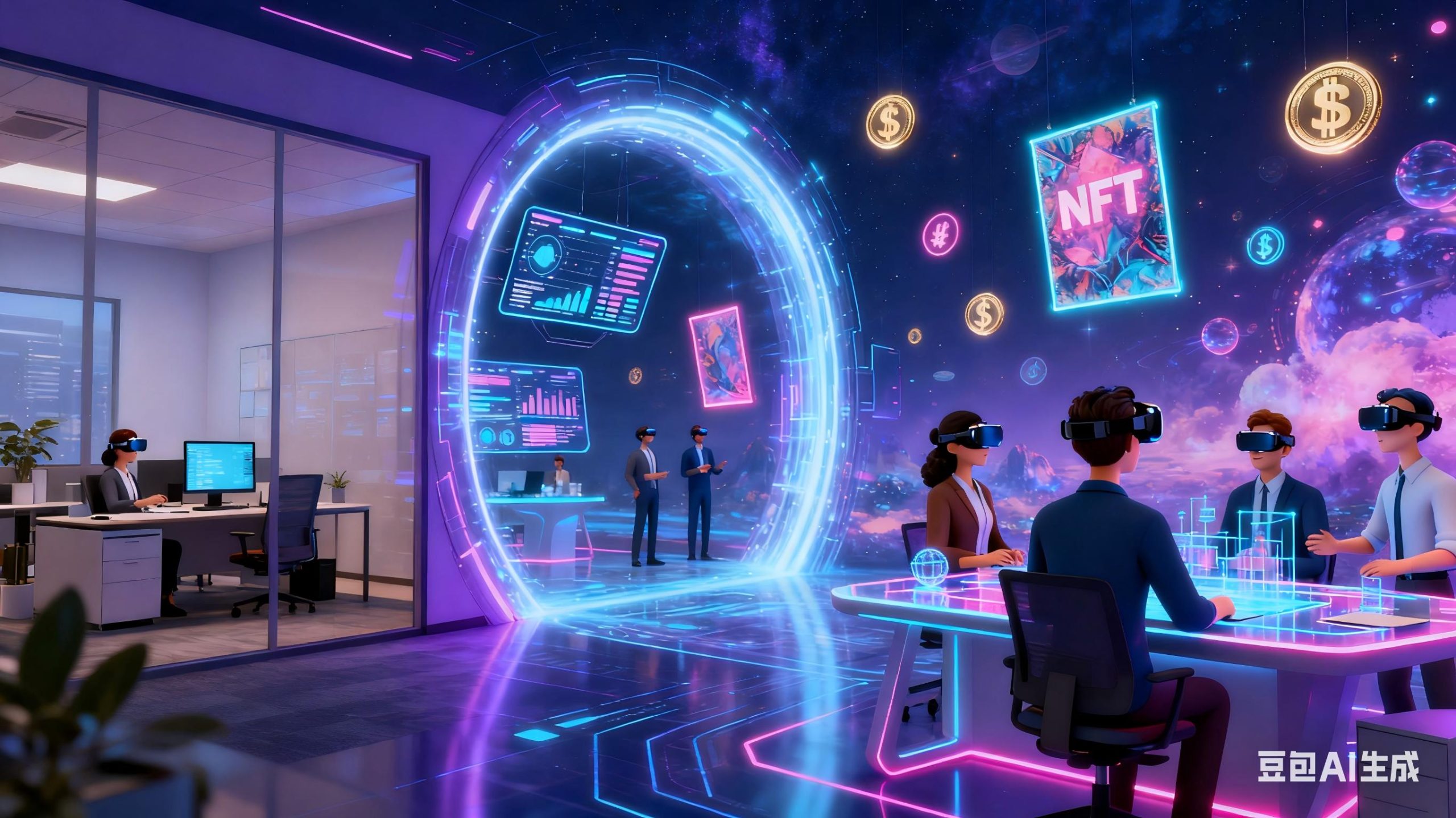
From tech giants to fashion brands, everyone is talking about the Metaverse. But what is it? Just a more realistic virtual game, or a marketing stunt by Facebook (Meta)? Cutting through the fog, we find that the Metaverse represents the next evolution of the internet—a new digital frontier that is more immersive, experiential, and economically significant.
Setting aside complex jargon, the Metaverse can be understood as a persistent, shared, converging virtual space that blends the physical and digital. It is not a single app, but a network of countless interconnected virtual worlds, experiences, and economies.
Four Core Characteristics of the Metaverse:
- Persistence: This world does not pause or reset when you log out. It runs 24/7, and the constructions and changes within it are permanent.
- Immersion: Through technologies like Virtual Reality (VR) and Augmented Reality (AR), the Metaverse aims to provide a highly immersive “sense of presence,” making you feel like you are truly “inside” it, not just “looking at a screen.”
- Interoperability: The ideal Metaverse is open. Your digital identity and virtual items (assets) can seamlessly travel across different virtual worlds, much like your WeChat avatar and wallet can be used across different mini-programs.
- Economic System: The Metaverse has its own independent economy. Users can create value through content creation and providing services, and truly own their digital assets (digital property rights) based on technologies like blockchain, enabling trade and consumption.
The Core Value of the Metaverse: Reshaping Experience and Connection
Its value goes far beyond entertainment.
- The Evolution of Socializing: Future friend gatherings might not happen on a group video call, but on a virtual beach, watching a shared sunset, with everyone’s avatars displaying real-time expressions and movements.
- The Transformation of Work: Remote work will no longer be monotonous video call grids. Instead, you could collaborate with global colleagues in a virtual 3D office, discussing a three-dimensional product model as if you were all in the same room.
- Empowerment for Industries: Automakers can simulate crash tests in the Metaverse without destroying a single physical car. Real estate agents can take clients “inside” a yet-to-be-built show flat. Schools can organize students to “walk” into ancient Roman battlefields to learn history.
The Metaverse is not meant to replace the real world, but to extend and enhance it. It offers us the possibility to create, socialize, and transact in new dimensions. Although the fully mature Metaverse is still years away, the future it points toward—an era of symbiotic virtual and real worlds, where experience is king—has quietly begun.
Leave a Reply