

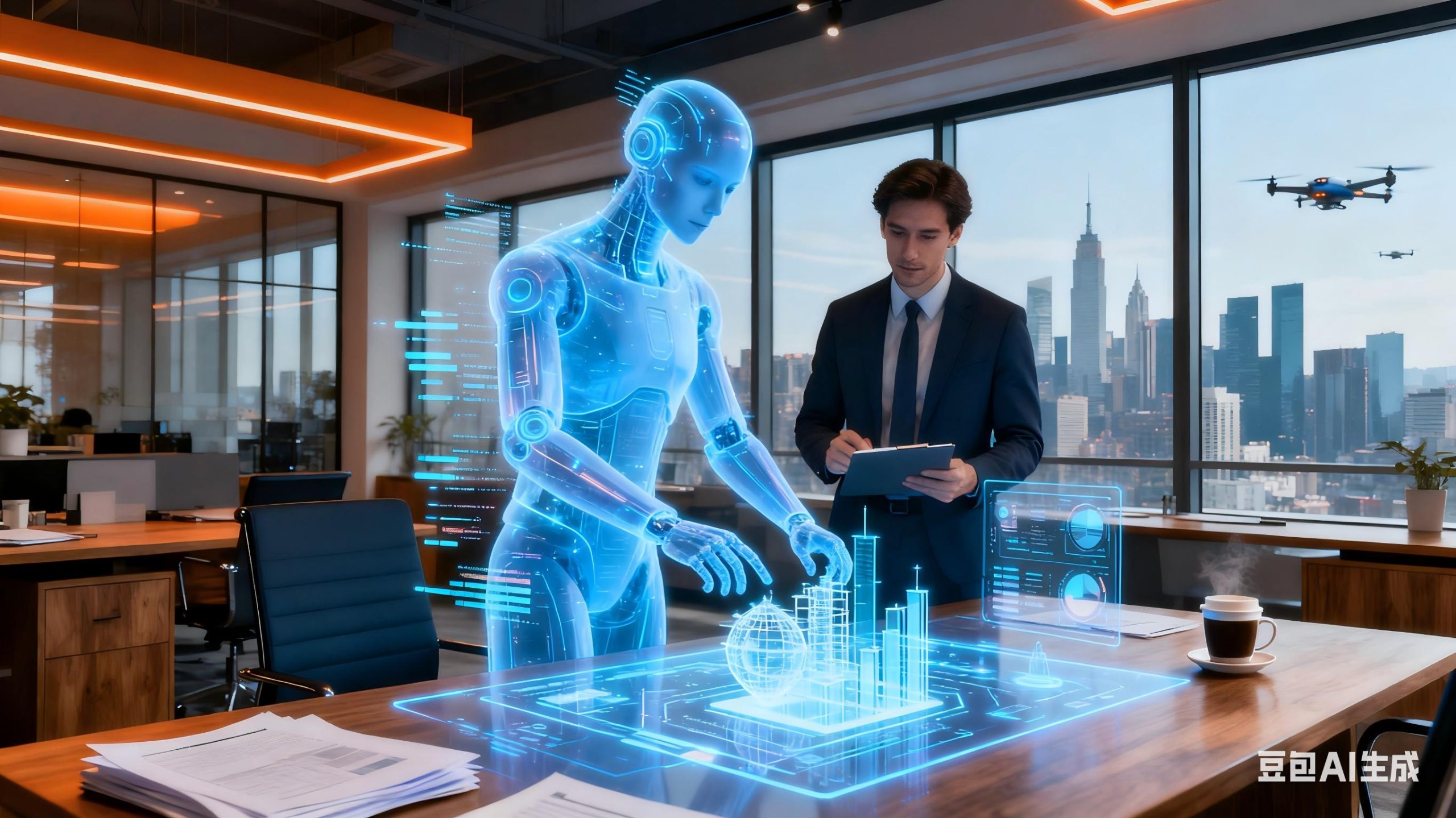
When AI is no longer just assisting us with tasks but can independently take on and complete the responsibilities of an entire job role, how will our work methods, company structures, and even the entire economic landscape change? The advent of AI Agents heralds a profound workplace revolution.
Body:
The core of an AI Agent is to simulate the complete workflow of a professional role. It is not a simple chatbot, but a “virtual employee” capable of handling business end-to-end.
A New Vision of the Future Workplace:
- The “One-Person Army” Becomes Possible: An entrepreneur can employ multiple AI Agents as customer service, market analyst, content creator, and financial assistant. The entrepreneur themselves can then focus on strategic decision-making and resource integration, operating a fully-functional company at a minimal cost.
- Super-Specialists and Universal Assistants: In professional fields, AI Agents can act as diagnostic assistants for doctors, rapidly analyzing vast amounts of medical literature and patient data, or as case researchers for lawyers, retrieving all relevant precedents in seconds. For the average employee, a personal AI assistant can handle all mundane tasks like email filtering, meeting scheduling, and report generation, significantly boosting core work efficiency.
- Seamless 24/7 Operations: AI Agents don’t need rest, enabling never-ending customer service, system monitoring, and global market trading, taking business operational efficiency to new heights.
Challenges and Reflections:
However, this transformation comes with significant challenges and uncertainties.
- Job Market Restructuring: A large number of repetitive, process-driven white-collar jobs (e.g., data entry, junior customer support, basic analysis) are most susceptible to replacement by AI Agents. Society needs to consider how to retrain the workforce and explore new wealth distribution mechanisms (like Universal Basic Income, UBI).
- Security and Accountability: If an autonomously acting AI Agent makes a wrong decision (e.g., a faulty investment trade), who is responsible? The developer, the owner, or the user? Ensuring that AI Agents act safely, compliantly, and ethically will be a serious challenge.
- Redefining Human Value: When intelligence and efficiency are no longer humanity’s core advantages, what is? Creativity, critical thinking, emotional intelligence, strategic insight, and ethical judgment—these uniquely human capabilities will become more important than ever.
Conclusion: AI Agents are not coming to replace humans, but to replace humans who refuse to use AI. They free us from repetitive labor, pushing us toward more creative and empathetic work. Actively embracing this trend and continuously enhancing our own irreplaceable value is the only choice for each of us in the face of this workplace transformation.
Leave a Reply