

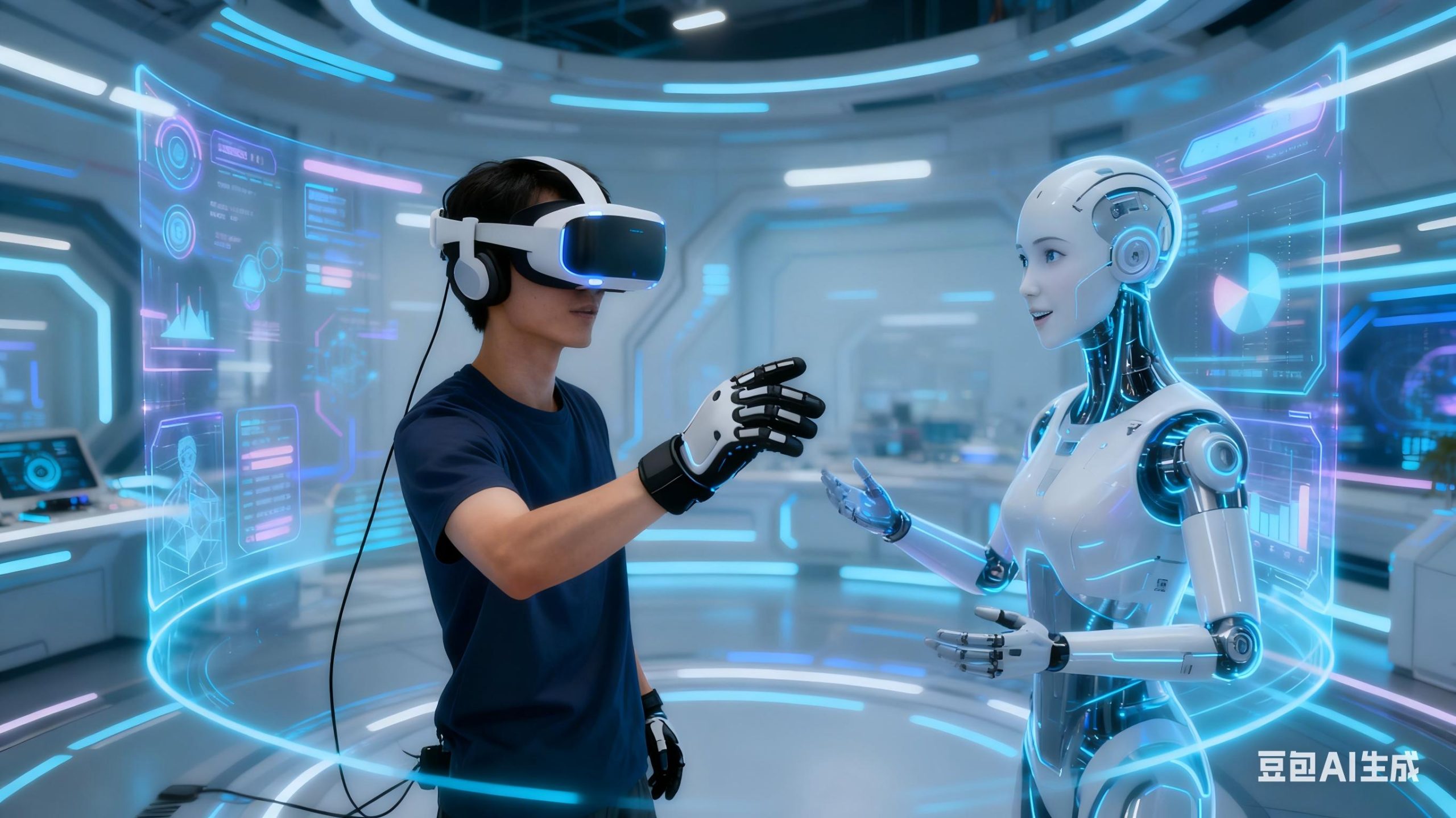
The grand vision of the Metaverse is not a castle in the air; it relies on the coordinated development and breakthroughs of a series of cutting-edge technologies. These technologies are the “bricks and mortar” for building the Metaverse, collectively forming the foundation of this vast digital empire.
To understand how the Metaverse moves from concept to reality, we need to focus on the following core technological pillars:
1. Immersive Interaction Technologies: The “Gateway” to the Metaverse
- Virtual Reality (VR): Uses headsets to completely immerse the user in a fully computer-generated 3D environment. This is key to achieving deep immersion.
- Augmented Reality (AR): Overlays digital information (e.g., images, models) onto the real world, blurring the lines between virtual and real. Imagine seeing virtual road signs through AR glasses or previewing how a new sofa looks in your living room.
- Brain-Computer Interface (BCI): This is a more frontier area aimed at enabling direct communication between the brain and a computer. In the long term, it could become the ultimate interaction method for the Metaverse, enabling “thought control” and “full sensory simulation.”
2. Networking and Computing Power: The “Circulatory System” of the Metaverse
- 5G/6G Networks: The Metaverse requires the real-time transmission of massive amounts of 3D graphics and data. Low-latency, high-bandwidth communication networks are essential for a smooth, stutter-free experience.
- Edge Computing: Pushing computing tasks from the cloud closer to the user at the network edge significantly reduces latency, meeting the stringent real-time requirements of applications like VR/AR.
- Cloud Computing: Provides nearly limitless, scalable computing resources to support the massive virtual worlds with billions of concurrent users.
3. Creator Economy and Digital Property: The “Soul and Law” of the Metaverse
- Blockchain and NFTs: Blockchain provides a decentralized identity system and an immutable economic ledger for the Metaverse. NFTs establish the uniqueness and ownership of digital assets (e.g., virtual land, clothing, artwork), enabling users to truly “own” their digital property and trade it freely, thereby fostering a thriving creator economy.
- 3D Modeling & Game Engines: Tools like Blender for 3D modeling and game engines like Unity and Unreal Engine are the “production lines” for building the rich visual content of the Metaverse. They make creating high-quality, interactive 3D environments more efficient than ever.
4. Artificial Intelligence: The “Nervous System” of the Metaverse
- AIGC (AI-Generated Content): AI can automatically create realistic 3D environments, generate lifelike virtual human avatars, and write dialogue for game quests, dramatically lowering the barrier and cost of content creation.
- Intelligent NPCs: Non-player characters in the Metaverse will be powered by AI, enabling them to engage in natural, meaningful conversations with users, possessing their own “personalities” and “memories,” making the virtual world feel alive.
Building the Metaverse is a technological “mega-project.” No single technology can accomplish it alone. Only when these technologies mature and deeply integrate will the vibrant
Leave a Reply